

Muta: The Beginning of a Painting
2026 · Oil on stretched canvas · 120 × 180 cm
Some paintings begin with an idea. Others begin with a feeling. Muta began with a photograph.
It was not simply a photograph of a cat that made me want to paint him. There was something in his expression, his stillness and the particular quality of his face that stayed with me. The longer I looked at the image, the more I began to see beyond the subject itself, the structure of the face, the changing silver tones of the coat, the quietness in his expression. I knew almost immediately that I wanted to paint him very large.
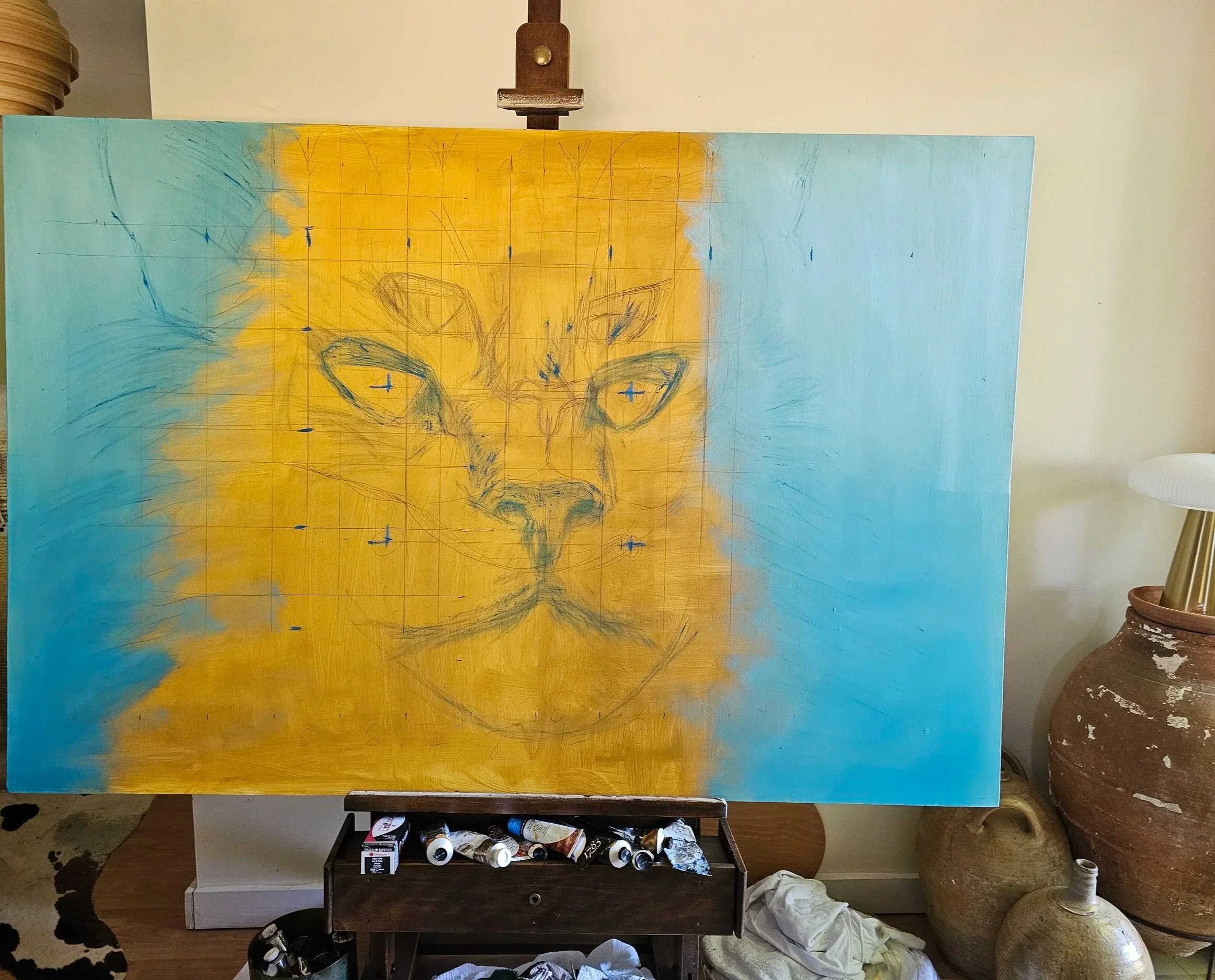
Beginning with the face
Muta is part of my developing Close-Up Figures series, a body of work exploring animals through intimate, enlarged portraits. The intention is not to create a conventional pet portrait. I am interested in what happens when the face becomes almost a landscape of its own. At a much larger scale, small things become important: the shape of a muzzle, the direction of a gaze, the subtle transition between light and shadow, the individual strands of fur. The viewer is brought close enough to notice things that might otherwise disappear.
For Muta, I wanted to preserve that sense of quiet observation. The painting is deliberately horizontal, measuring 120 × 180 cm. The scale gives the face room to breathe while allowing the surrounding areas of silver fur, shadow and negative space to become part of the composition.
Finding the structure before the colour
The beginning of a painting is often the least glamorous part. Before the colour, there is measurement. Before the detail, there is structure. I spent time carefully transferring the proportions of the reference photograph onto the large canvas, paying particular attention to the position of the eyes, nose and muzzle. At this stage, the painting can look surprisingly simple, almost fragile compared with what it will eventually become.
But this stage matters enormously. If the underlying drawing is not right, no amount of beautiful brushwork can completely rescue the painting. So I am resisting the temptation to rush. Muta's face has to be established first.
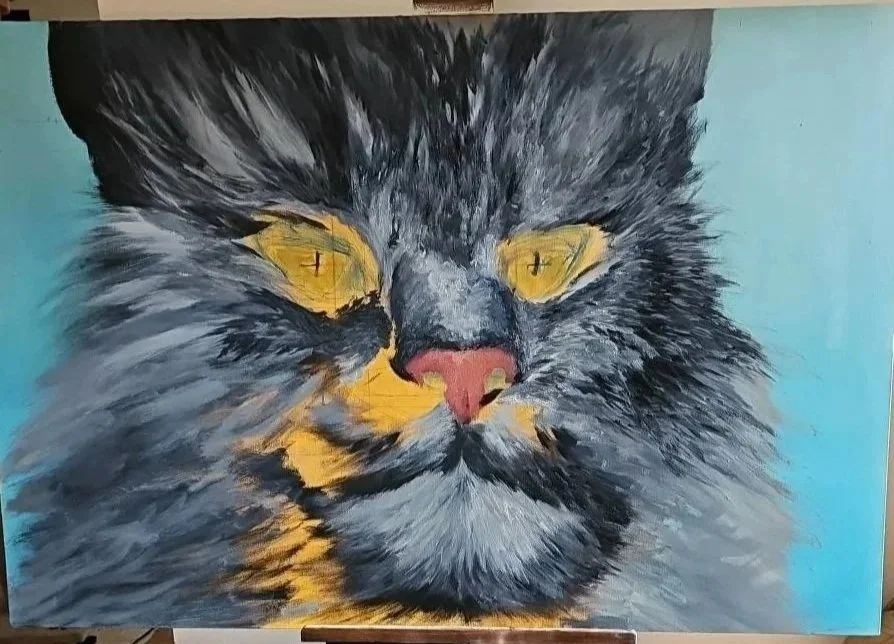
Learning to paint silver
One of the things I find most interesting about Muta is that silver is not really silver. It is a collection of colours. There are warm and cool greys, deep shadows, soft whites, muted browns and subtle blue-violet notes. The coat changes constantly according to the light. This is one of the reasons I chose oil paint. Oil allows me to build those transitions slowly. I can soften one area, deepen another, allow one passage of paint to remain visible and then return to it later with a transparent glaze or a more precise stroke.
I am not trying to paint every hair. I am trying to understand the mass of the coat first — how the light travels across it, where the form turns away, and where the darkest passages give the face its structure. The individual hairs will come later.
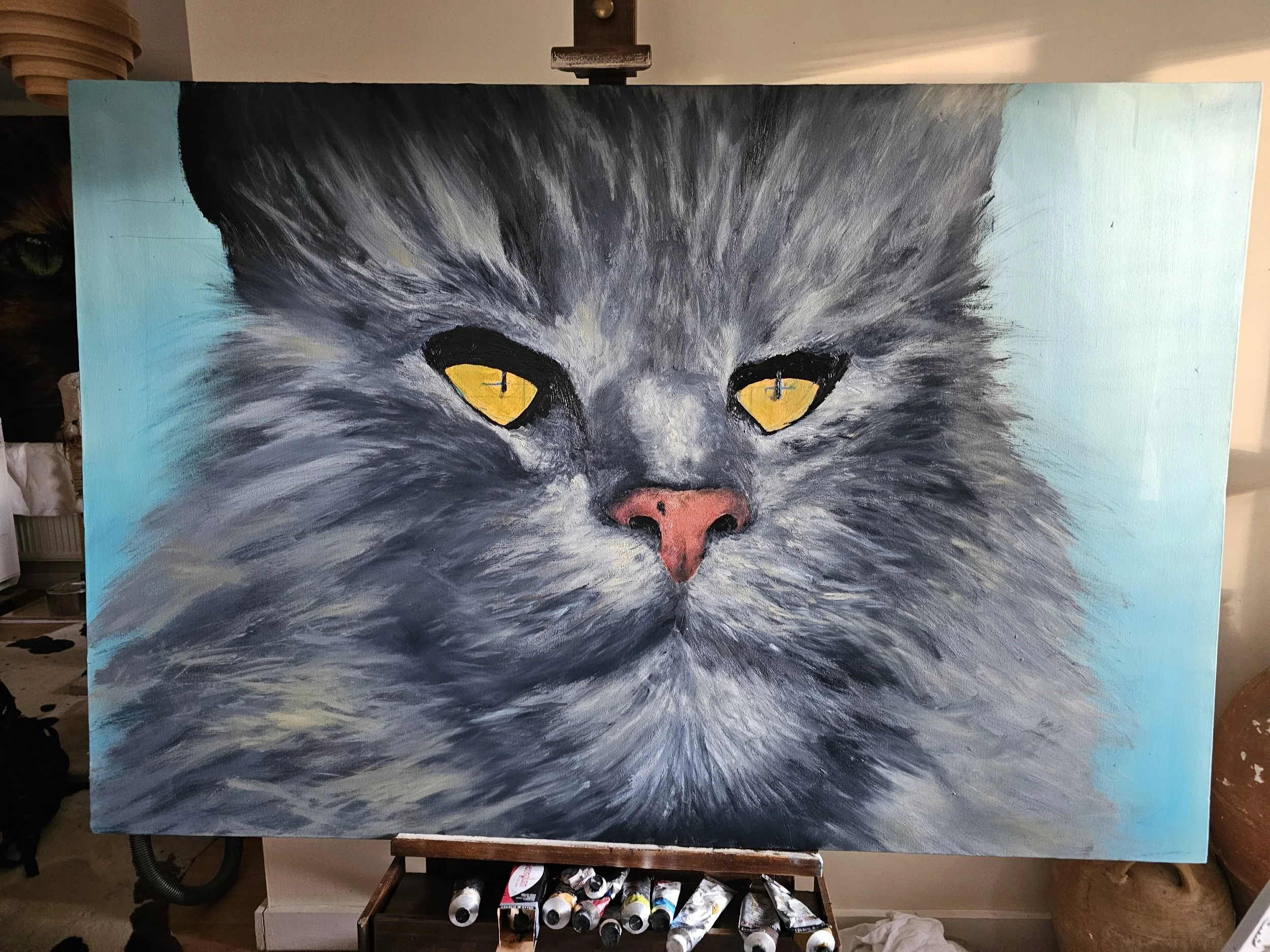
The eyes
As with Yuki, the eyes are becoming one of the most important parts of the painting. They are also one of the areas I am trying hardest not to overwork. There is always a temptation when painting an animal to make the eyes immediately beautiful and expressive. But expression does not come from adding more detail. It comes from getting the relationships right, the shape of the eye, the surrounding fur, the shadow beneath the brow, the direction of the gaze and the tiny variations in light.
I want Muta to feel as though he is simply there. Not posed. Not performing. Just looking back.
A painting that needs time
At this early stage, Muta is nowhere near finished. And that is exactly where I want him to be.
There is something valuable about allowing a painting to remain unresolved for a while. It gives me the opportunity to step back, live with it, look from a distance, return to it the following day and see what has changed. Large paintings especially need patience. At 180 centimetres wide, Muta cannot be understood entirely from a few inches away. I need to move around him. I need to see how the whole composition holds together before I become too concerned with individual details. The painting has to work both as an image and as a physical presence.
Following the painting rather than forcing it
One of the things I am learning through this series is that painting is not simply a matter of reproducing what I can see. It is a process of deciding what matters. What should remain quiet? Where should the eye rest? Where should the paint be precise? Where can it be allowed to breathe? These decisions are becoming increasingly important to me.
I want the finished painting to retain something of the stillness that made me choose the photograph in the first place. I don't want to paint away all of the mystery.
The beginning of Muta
For now, Muta is still mostly a beginning. The drawing has found its place on the canvas. The first layers of paint are beginning to establish the forms. The face is emerging slowly from the surface. There will be many more stages. There will be corrections, lost edges, darker passages, softer transitions and countless small decisions before I know whether the painting has arrived where I want it to go. But that is part of why I love painting.
A photograph gives me a moment. A painting gives me time.
Muta's journey has only just begun. And I am looking forward to discovering where it takes us.