

I have always been fascinated by the way a painting can change a room. Not necessarily through its size, colour or subject, although these things matter. Sometimes it is something much less obvious. A painting can alter the atmosphere of a space without changing anything else within it. A room that once felt ordinary can suddenly feel more considered. A quiet corner can become somewhere we want to spend time. A wall that seemed unimportant can begin to hold our attention.
And sometimes, one painting is enough.
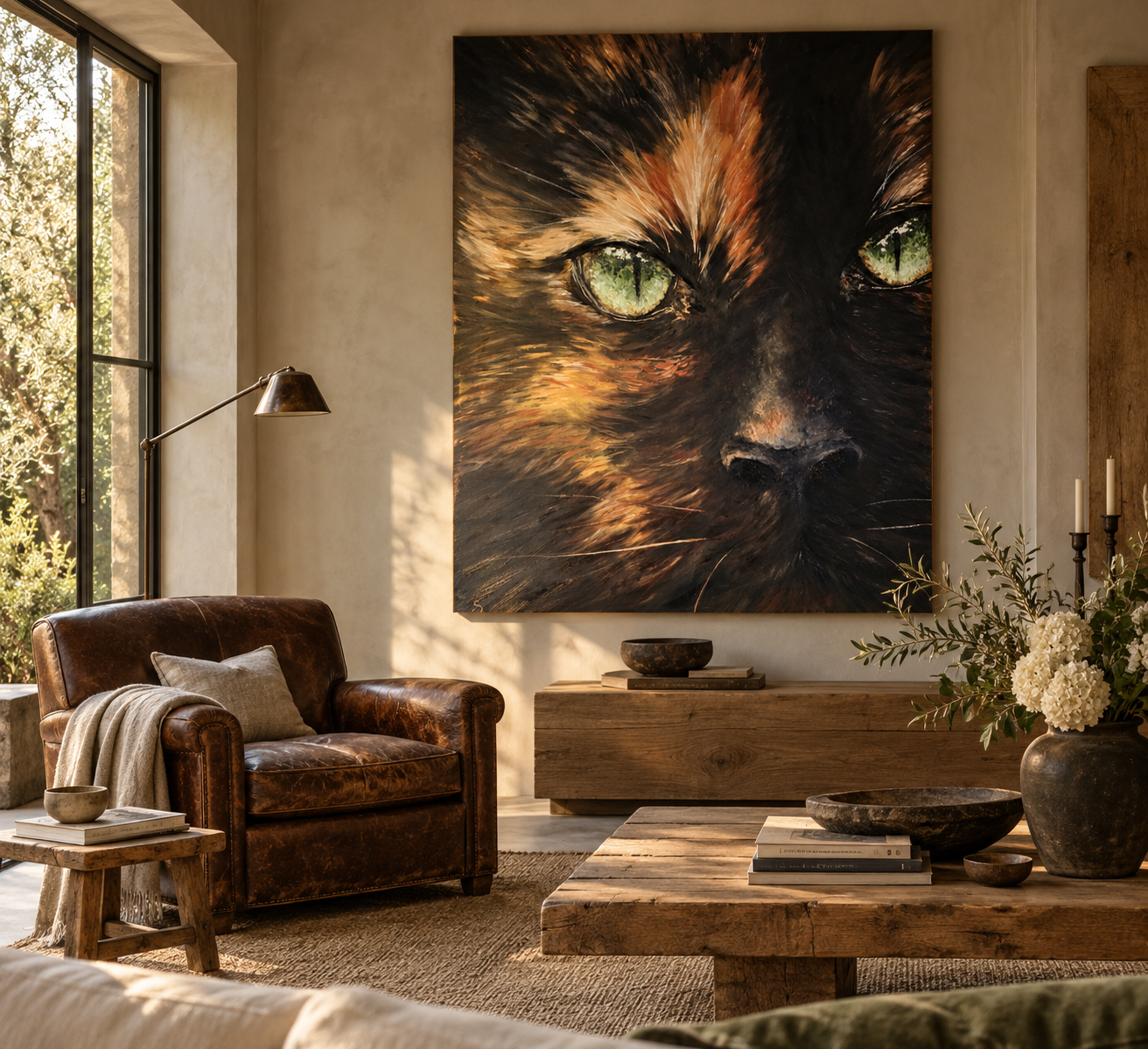
Yuki painting in living room
The difference between decorating and living with art
There is a difference, I think, between choosing something to decorate a wall and choosing a painting because it means something to us. Decoration often begins with a room. We consider the colours, the furniture, the proportions and the space that needs filling. But choosing art can begin somewhere entirely different. With a feeling.
A painting catches our attention, perhaps unexpectedly. We find ourselves returning to it. Something about the colours, the expression, the composition or the atmosphere stays with us. We may not even be able to explain why. I think that is often the beginning of a meaningful relationship with art. Not whether it matches the room, but whether we want to live with it.
Giving a painting room to breathe
I am increasingly drawn to interiors where fewer things are allowed to have greater importance. A beautiful painting doesn't necessarily need to be surrounded by other beautiful objects. Sometimes it needs the opposite. A simple wall. A little space. Natural light. Perhaps a piece of furniture beneath it, chosen for its proportions rather than its decorative qualities.
I love the idea of a large painting hanging above an old oak table, with nothing more than a ceramic bowl or a few branches nearby. The materials have their own character, but they don't compete. They create a quiet conversation. And the painting becomes part of the architecture of the room.
Scale changes everything

Muta painting - close up eyes
Working on large canvases has made me think differently about scale. A painting measuring 180 × 120 centimetres is not simply a larger version of a small picture. It creates a different relationship with the viewer. You don't just look at it from a distance. You encounter it.
The colours occupy more of your field of vision. The brushstrokes become more visible. Small details take on an unexpected significance. This is something I have been exploring through my Close-Up Figures series.
By bringing familiar subjects unusually close, I want to change the way we experience them. An eye becomes a focal point. A passage of fur becomes an arrangement of colour and movement. The familiar begins to feel almost abstract. In a room, this scale can create a powerful presence. But I don't believe that presence needs to be overwhelming. A large painting can be surprisingly quiet. Its impact depends not only on its dimensions, but on the relationship between colour, composition, surrounding space and light.
Art and the atmosphere of a home
I don't think a painting has to be peaceful in order to belong in a calm home. Sometimes a little tension is exactly what a room needs. An expressive painting can bring movement into an otherwise restrained interior. A dark painting can create depth against pale plaster walls. An unexpected colour can make natural materials feel richer. The contrast can be beautiful.
I particularly love the relationship between contemporary painting and materials that have a sense of age. Old wood. Linen. Stone. Worn leather. Handmade ceramics. These materials have subtle variations, marks and imperfections. They don't compete with the painting. Instead, they offer something grounded and familiar against which the artwork can express itself.
Perhaps this is why I am drawn to interiors that feel collected rather than decorated. They allow different things to coexist without requiring everything to match.
Living with a painting over time
One of the things I find most interesting about original art is that our relationship with it changes. A painting may initially attract us because of its colour or subject. But after living with it for a while, we begin to notice other things. A particular brushstroke. A subtle transition between colours. The way the surface catches the morning light. A detail that we had never noticed before. Some paintings reveal themselves slowly. And perhaps that is one of the pleasures of owning original art.
Unlike an image on a screen, a painting has a physical presence. Its surface carries the evidence of decisions made by the artist. Paint has been applied, moved, softened, removed and sometimes left deliberately unfinished. These marks become part of the experience. They remind us that the painting is not simply an image. It is an object made by another human being.
Choosing art without following rules
I am not particularly interested in rules about which paintings belong in which rooms. I don't think a bedroom must contain soft colours. Or that a living room requires a large landscape. Or that contemporary art only belongs in contemporary interiors. Some of the most interesting rooms are those where something unexpected has been introduced. A bold painting in a very traditional room. A small, intimate portrait in a large space. An expressive work against a beautifully simple wall. The important thing is not whether the combination follows a formula. It is whether it feels right.
I would rather see a painting chosen with genuine affection than one selected simply because it completes a colour scheme. A home should reflect the person who lives there. And art is one of the most personal ways of expressing that individuality.
When one painting is enough
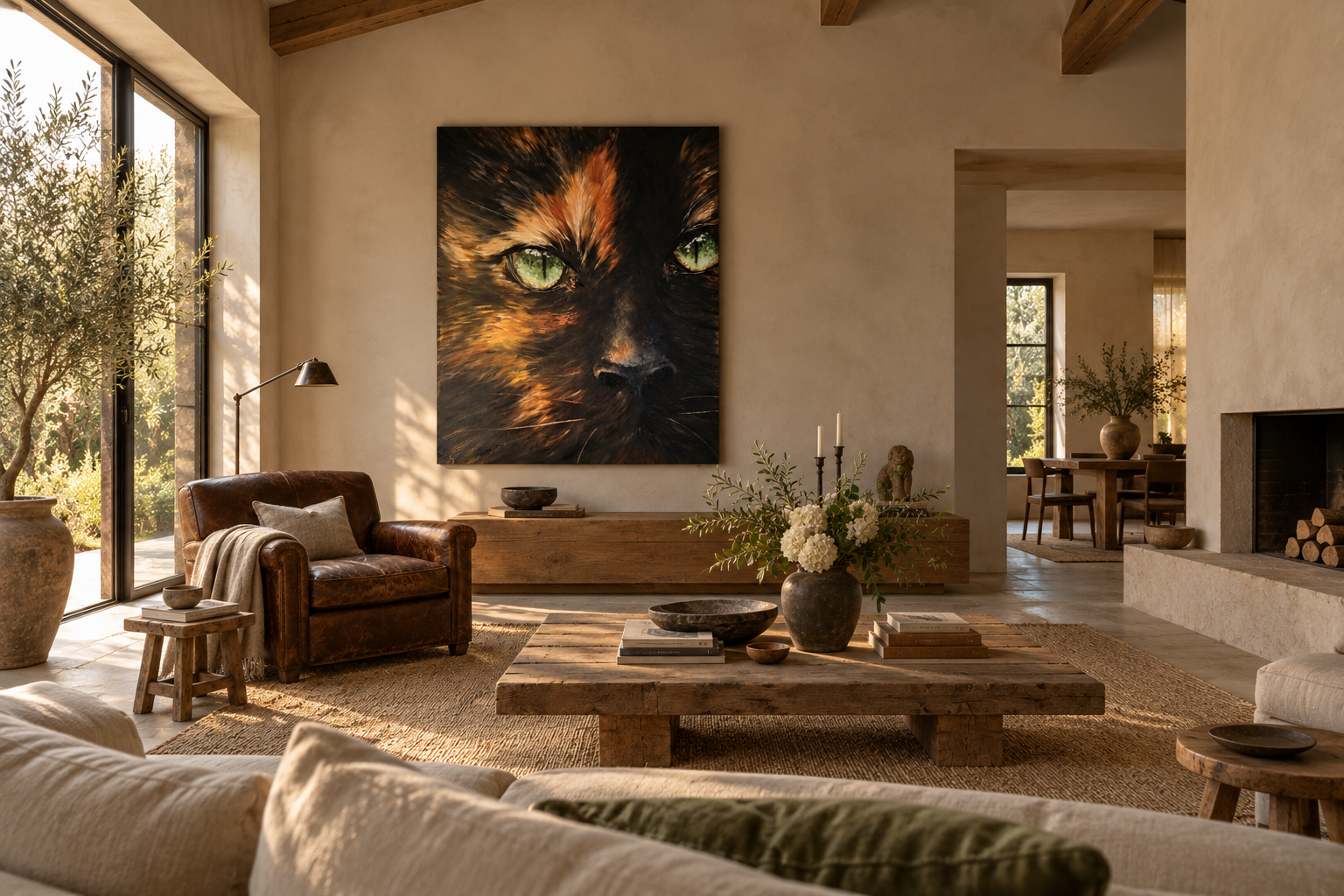
Yuki painting in living room
We live in a world that continually encourages us to add more. More furniture. More accessories. More colour. More things to make a room feel finished. But I have begun to appreciate the confidence of restraint. A room doesn't always need another object. A wall doesn't always need a collection of pictures. Sometimes the most beautiful decision is to choose one thing and allow it to have importance. One painting. One piece of furniture. One arrangement of flowers. Enough space around them to appreciate each properly.
This isn't about creating an empty or minimalist home. It is about understanding what deserves our attention.
Art as part of everyday life
I don't want art to feel distant or reserved for galleries. I want it to be something we live alongside. Something we see while making coffee, reading a book or walking from one room to another. Something that changes with the daylight. Something that becomes familiar without ever becoming entirely ordinary.
Perhaps this is what I find most compelling about the relationship between art and home. A painting doesn't need to dominate a room to influence it. It can simply be present. Quietly adding depth, character and a sense of individuality to the space. And over time, it becomes part of the life unfolding around it.
A room with something to say
When I imagine a beautiful home, I don't picture rooms filled with expensive things. I picture spaces where the objects have been chosen carefully. Where materials feel honest. Where there is room to breathe. Where the light is allowed to move across the walls. And where art has a place, not because it is fashionable or impressive, but because someone genuinely loves it.
A single painting can bring something into a room that furniture and decoration cannot quite provide. A sense of presence. A little mystery. An invitation to look again. Perhaps that is the quiet power of art. It doesn't simply change how a room looks. Sometimes, it changes how we experience being there.