

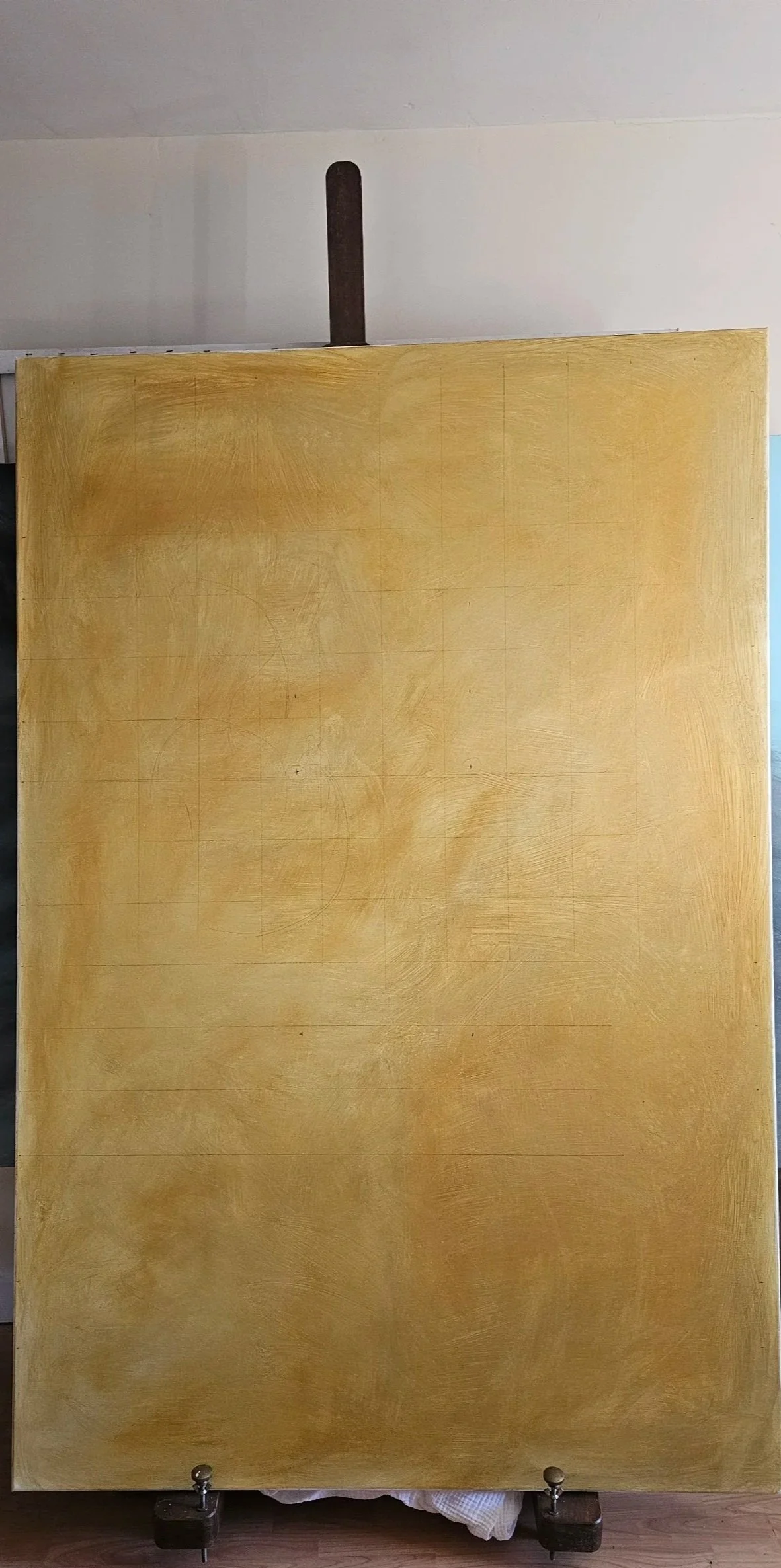
Blank Canvas
A blank canvas can be quite difficult to stand in front of. I can have the reference beside me, the colours laid out and a good idea of where I want to begin. Then I pick up the brush and find myself looking at the canvas for a little longer.
I feel this even when I have been looking forward to a painting. Sometimes the longer I have carried an idea, the harder it is to make the first mark. In my mind, I can see something of the finished piece. I know how I want it to feel. What I have in my hand is a brush with one colour on it.
On a large canvas, that first mark can look surprisingly small. Before it goes down, I can imagine a soft transition between light and shadow, or the way a figure might gradually emerge from the background. The mark itself is much more ordinary. It has a width, a direction and a colour. Already, there are things I can doubt. Is it too dark? Have I started too close to the centre? Would I have been better beginning somewhere else?
Oil paint can be wiped back or worked over. I know that, and yet I still hesitate. I think what I find daunting is how quickly I begin to judge a painting when it has barely begun. I have spent time with the idea, so there is a temptation to expect some sign of it in that first stroke. And the paint, on its own against the bare canvas, has very little to tell me.
A grey is a good example. On the palette it may seem cool enough. On a white canvas it can look much darker than I expected. Put a warmer grey beside it and I can suddenly see the blue in the first mixture. I needed both colours there before I could see what either was doing. This is one of the reasons I try to give the first marks a little company before I decide how I feel about them.
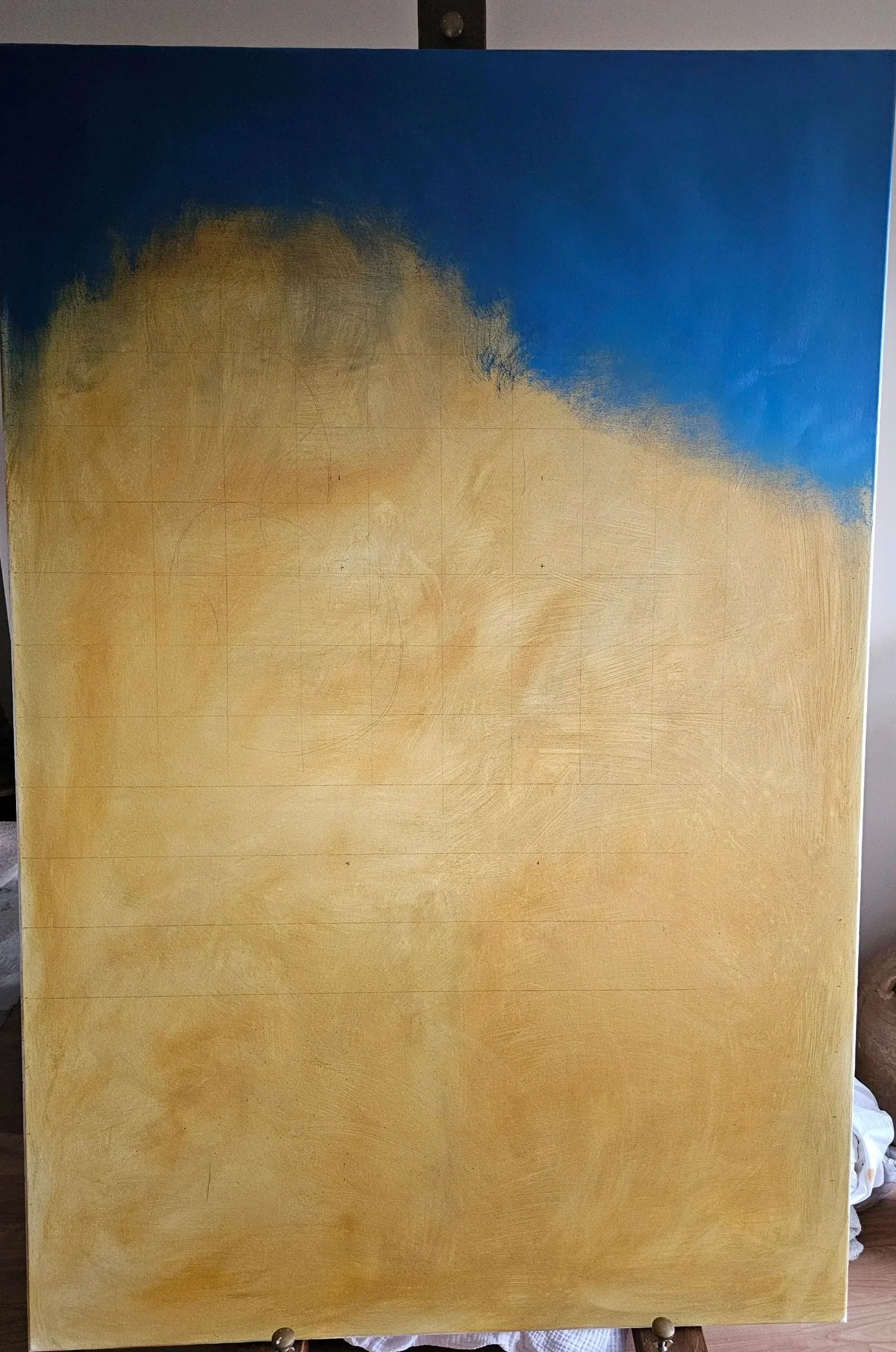
There is a moment, sometimes quite early, when my attention shifts. I am still uncertain about the painting, but there is something specific to look at. I can see that one shape needs to extend a little further, or that two areas I thought were separate might belong together. These are smaller questions than the one I brought to the blank canvas. I can do something with them.
I have just started painting a dahlia for my Close-Up Figures series, and I am in that early stage again. In the reference photograph, I keep coming back to the petals near the centre, where one edge catches the light and the next slips into shadow. I wonder how much of that detail the painting will need, and where a broad stroke might be enough. Having finished other paintings helps me recognise the hesitation. I still have to stand in front of this one and decide where to put the brush.
The unknown can be exciting, although I tend to feel that more once I have started. There might be a colour I had planned to use sparingly that turns out to matter more, or a corner of the composition I can leave very quiet. I can prepare for a painting with care and still be surprised by what looks right when it is there at full size. I like that about painting. I also find it difficult.
When I think of the first brushstroke now, I try to give it a modest job. It might place the beginning of a shadow or give me a colour to mix against. If I can make that one decision, I have somewhere to look when I step back.
There will still be a great deal of bare canvas around it. When I come back to the painting, that small patch of colour will be there, and I can see what happens when I put something beside it.